“My life and my story are tied to Monforte d’Alba — to its people, its vineyards, and its wines.
In 1982, I began a journey filled with great satisfaction, together with Claudio, my cousin, and Guido Fantino.
At the dawn of the new millennium, I brought an end to a wonderful partnership in search of new motivations.
A gentleman is always honest.
It is difficult to keep me from working — the passion is too strong.
And so, I return to my land once again, but now in first person.”**
Diego Conterno
Diego felt that the time had come to celebrate a more natural expression of Nebbiolo.
In 2000, he left the family project to start his own, taking with him nearly 2 hectares in Ginestra — one of the most important crus of Monforte, owned by his family.
In 2009, his son Stefano joined the estate, bringing new energy and expanding sales into new markets.
The estate organically cultivates around 9 hectares of vineyards in the village of Monforte d’Alba, located on the southern edge of the Barolo area.
The family’s historic holdings include the “Sorì” parcel — the southern part of Ginestra, planted in 1982.
Other parcels include vineyards in Pajana and Gris (the Gris area of Ginestra), as well as San Pietro and Perno — all located in Monforte.
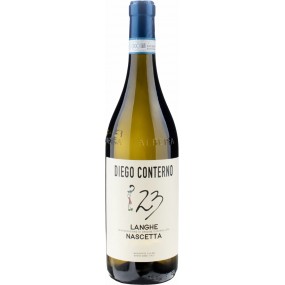
Nebbiolo vines (for Langhe Nebbiolo), as well as Barbera, Dolcetto and Nascetta, are planted in Ferrione — a west-facing site adjacent to the family winery, which was restored in 2005.
The Barolo production zone, officially recognized in 1966 with DOC status, has remained unchanged to this day and includes the territories of 11 municipalities:
Barolo, Serralunga d’Alba, and Castiglione Falletto fall entirely within the zone;
Diano d’Alba, Novello, Roddi, and Verduno are included only in part.
The continental climate of the Langhe has distinctive features that make this region unique.
The Apennines protect the hills from the influence of maritime winds.
Air masses from the Mediterranean meet those descending from the Alps, preventing cold northern currents from reaching the hills.
Natural climatic variations are frequent and are clearly expressed in the glass — each vintage differs from another, creating endless diversity of flavors and aromas.
Barolo enjoys moderate temperatures, influenced by the Alps and the warm winds rising from the Tanaro Valley.
Three mountain chains create heterogeneous landscapes and, consequently, a variety of microclimates.
The Langhe soils originate from the Ligurian-Piedmontese Tertiary Basin.
The main soil types in Monforte include:
• Lequio Formation (Serravallian age): alternating sandstone and marl, resulting in soils rich in clay and limestone
• Diano Sandstones (Tortonian age): sandy layers formed by marine deposits, with lower clay and limestone content
Vineyard work follows organic principles.
Since 2015, the grapes have been certified organic by CCPB.
Soil management is done manually or mechanically without herbicides.
Harvesting is conducted exclusively by hand.
In the cellar, grapes ferment and age on native yeasts in temperature-controlled stainless-steel tanks.
Barolo ages in traditional large oak casks (botti), followed by additional refinement in neutral cement tanks prior to bottling.


 Diego Conterno